Dubai construction costs rose almost as much in six months as in the previous seven years
Official index data, and what a jump like this means if you are waiting on an off-plan handover.
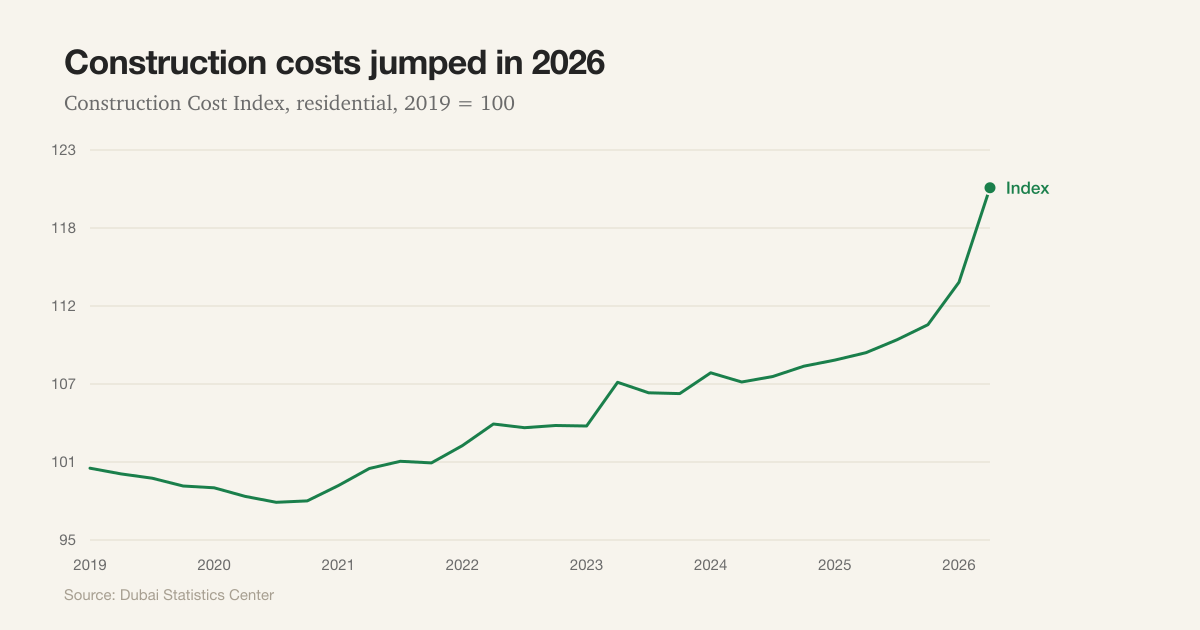
Dubai's Construction Cost Index sat at 110.84 at the end of 2025, against a 2019 base of 100. Seven years of building had added about 10% to the cost of putting up a residential building.
By June 2026 the same index read 123.05.
That is 8.8% in six months, against 10.2% in the preceding seven years. The second quarter of 2026 alone added 5.9%, which is more than any full year in the series.
The series
Residential buildings, general index, 2019 = 100.
| Period | Index | Change |
|---|---|---|
| 2019 Q1 | 100.60 | base |
| 2020 Q4 | 98.27 | below base |
| 2022 Q4 | 103.65 | |
| 2024 Q4 | 107.88 | |
| 2025 Q4 | 110.84 | +10.2% over seven years |
| 2026 Q1 | 113.87 | +2.7% in one quarter |
| 2026 Q2 | 120.61 | +5.9% in one quarter |
The monthly series shows where it happened. January 113.1, February 113.75, March 114.76, April 117.03, then May 121.76 and June 123.05. Most of the move lands in a single month.
It is the shell, not the fit-out
The interesting part is which trades moved. Since 2019:
| Building stage | Change since 2019 |
|---|---|
| Block works | +46.2% |
| Super structure | +40.7% |
| Concrete works, substructure and above | +37.9% |
| Foundations | +36.0% |
| Electrical works | +32.6% |
| Air conditioning | +30.0% |
| Finishing work (all) | +21.0% |
| Floor and wall tiles | +9.8% |
| Wages of workers and others | +9.1% |
Structural work has risen roughly four to five times as fast as labour and as the finishes buyers actually look at.
The material price series says the same thing. Hollow blocks are up around 50%, ready-mix concrete about 30%, cement about 29% and aggregates about 29%. Meanwhile gypsum has roughly halved and reinforcing mesh is down more than 20%.
So the expensive part of a building is now the part nobody photographs.
Why this matters if you are buying
It squeezes projects sold before it happened. An off-plan project priced in 2023 or 2024 and built through 2026 was costed against a very different index. That pressure lands on the developer's margin, and margin pressure is what turns into specification changes and slipped handover dates. It is not a reason to panic; it is a reason to check your developer's delivery record and your contract's completion clause rather than assuming the anticipated date.
It changes what "cheap" means. If replacing a building costs materially more than it did eighteen months ago, a completed building is a different proposition against a new one than it was. Even after this jump, prices have risen about six times as far as build costs since 2019. That is an argument about replacement cost, not a forecast about prices.
It feeds service charges eventually. Maintenance, repairs and replacement all track the same materials. Charges tend to move a year or two behind, not immediately.
What this data does not tell you
Being clear about the limits, because this is one index and the jump is unusual:
- An index is not a price. It measures the cost of building, not what anything sells for. Costs and prices move independently and often in opposite directions.
- A 4% single-month move is exceptional and worth watching for revision in later releases. The quarterly and monthly files agree, but they are published by the same body and may share underlying inputs.
- It says nothing about where prices go next. We do not forecast, and anyone reading a construction index as a price prediction is over-reading it.
- Two stages look like placeholders. Lift works records no change at all since 2019, and communications is down more than 30%, both of which suggest imputed rather than observed data. Treat those lines with suspicion.
Method
Figures are from the Dubai Statistics Center Construction Cost Index and its average construction material prices series, published August 2026, unmodified.
Every number above is derived by a script kept with the site, so the arithmetic can be checked rather than taken on trust. Index levels are the residential general index on a 2019 base; material comparisons run from the first to the latest observation in the published series, which for materials begins earlier than 2019.